
CDU Pump Selection Guide: Flow Rate, Head, and Power for Rack-Level Cooling
Published:2026-10-17
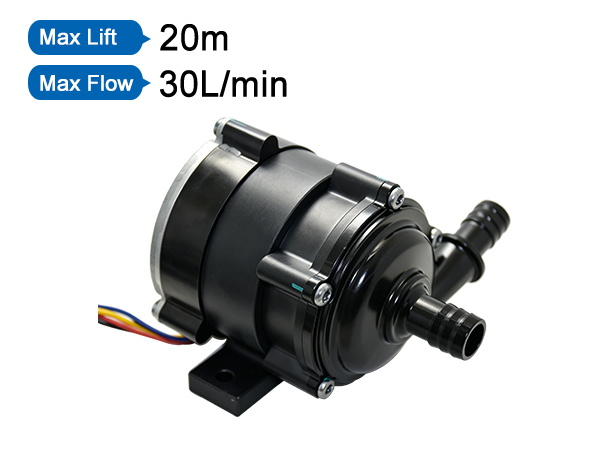
The pump inside a rack-level CDU is selected on three numbers: flow rate, head, and power. For most single-rack and dual-rack loops in 2026-era AI data centers, a 24 V brushless DC pump with up to 25 L/min of flow and 27 m of head covers the practical range, while 48 V architectures step up to 30 L/min. The right choice is not the biggest pump that fits — it is the pump whose duty point matches the heat load of the rack and the pressure drop of the loop. This guide shows how to derive those three numbers from your own system and map them to a specific model.
Step 1: Turn the Heat Load Into a Required Flow Rate
Liquid cooling removes heat by raising coolant temperature as it passes through the loop. The flow rate you need follows from the heat you must remove and the temperature rise you allow:
Flow rate = Heat load ÷ (Coolant density × specific heat × ΔT)
For a 15 kW rack with a 10 °C temperature rise across the loop, water-based coolant requires roughly 21–22 L/min. Double the heat load and you double the flow; narrow the ΔT to 5 °C and you need roughly twice the flow again. Two practical rules:
1) Size from the worst-case rack heat load (the sum of GPU TDPs plus overhead), not the average.
2) Allow a temperature rise of 8–12 °C at the rack CDU. A wider ΔT reduces flow but raises return temperatures, which the facility heat-rejection plant has to handle.
Step 2: Estimate the Head You Need From the Loop, Not From the Rack
Head is the pressure energy the pump must add to push coolant through every restriction in the loop, and it is the most underestimated number in CDU sizing. Count every element:
Cold plates: high-performance plates can add 3–8 m of pressure drop each.
Quick disconnects and manifolds: typically 1–3 m total on a rack loop.
CDU internals: filters, heat exchanger, and valves add several meters.
Pipe runs and fittings: small but not zero.
A rack loop commonly totals 8–20 m of dynamic head, before any margin. Add 10–20% for fouling and filter loading. If the loop feeds two racks or uses high-impingement cold plates, the top of that range applies. This is why a 24 V pump with 27 m of head — the P6092 — is a common rack-CDU choice, while the P4552 (11 m of head) suits simpler, lower-drop loops.
Step 3: Match Voltage and Power to Your Server Architecture
Model | Voltage | Max flow rate | Max head | Rated power |
P6038 | 12 V | 6 L/min | 3 m | 10 W |
P4552 | 24 V | 11 L/min | 11 m | 28 W |
P6092 | 24 V | 25 L/min | 27 m | 88 W |
P609248I04 | 48 V | 30 L/min | 20 m | 100 W |
Voltage follows the rack architecture, not the pump. Legacy and many current servers run 12 V or 24 V auxiliary power; OCP-style 48 V architectures are spreading fast because they halve distribution losses at a given power. Within one voltage there is still a wide duty range — on 24 V you can choose between 11 L/min (P4552) and 25 L/min (P6092). Rated power tells you the electrical input at maximum duty; a pump selected close to its actual duty point wastes less energy, which matters at rack density because pump efficiency directly affects PUE.
A Practical Selection Checklist
List the worst-case heat load per rack.
Choose a design ΔT (8–12 °C is typical).
Compute the flow rate; add a 10% margin.
Sum the pressure drops around the loop; add 10–20% margin.
Match the voltage to the architecture (12 V / 24 V / 48 V).
Pick the smallest model whose duty point covers both flow and head.
Check that rated power fits the CDU's electrical budget.
FAQ
Q: What flow rate does a rack-level CDU pump typically need?
A: For a 15–25 kW rack with a 10 °C temperature rise, roughly 20–35 L/min. Calculate it from heat load and ΔT rather than guessing.
Q: How much head does a rack CDU pump need?
A: Count every restriction in the loop — cold plates, quick disconnects, manifolds, and CDU internals — then add margin. Most rack loops fall between 8 and 20 m.
Q: Should we spec 24 V or 48 V?
A: Match the server architecture. 24 V remains the most common rack standard; 48 V is growing quickly in AI racks and OCP designs. Choose the voltage first, then the duty point.
Q: Can one pump serve two racks?
A: Yes, if its flow and head budget covers both loops combined. The P6092 (25 L/min, 27 m) and the 48 V P609248I04 (30 L/min, 20 m) are the models to evaluate for dual-rack CDUs.
Q: How do we confirm a pump fits our CDU?
A: Send your heat load, target ΔT, and loop pressure-drop estimate to the pump supplier. A properly sized pump is a design collaboration, not a catalogue pick.
Pump Support for Rack-Level CDUs from Shenpeng Technology
Shenpeng Technology manufactures the brushless DC pumps used inside rack-level CDUs: the P4552 (24 V, 11 L/min, 11 m, 28 W), the P6092 (24 V, 25 L/min, 27 m, 88 W), and the 48 V P609248I04 (30 L/min, 20 m, 100 W). Contact our engineering team with your heat load, target ΔT, and loop layout — we will confirm the flow rate and head your CDU needs and recommend the right model.
- CDU Pump Selection Guide: Flow Rate, Head, and Power for Rack-Level Cooling
- How to Choose the Right Data Center Liquid Cooling Pump for Your CDU
- Distribution in Water Heater Mattresses: Why BLDC Pumps Ensure Uniform Heating
- How BLDC Pumps Ensure Precise Flow in Water Dispensers
- Why BLDC Pumps Are Essential for Smart Toilets
- The Critical Role of Automotive Electronic Water Pumps in New Energy Vehicle Battery Thermal Management
- Noise Control Technology for Smart Toilet Water Pumps: Enhancing Quiet Operation in Modern Bathrooms
- Unveiling the Working Principle of Automotive Electronic Water Valves
- Comparative Analysis of Liquid-Cooled Pumps vs. Air-Cooled Systems for EV Charging Stations
- Technical Application of Brushless DC Motors in Energy Storage Circulation Pumps